
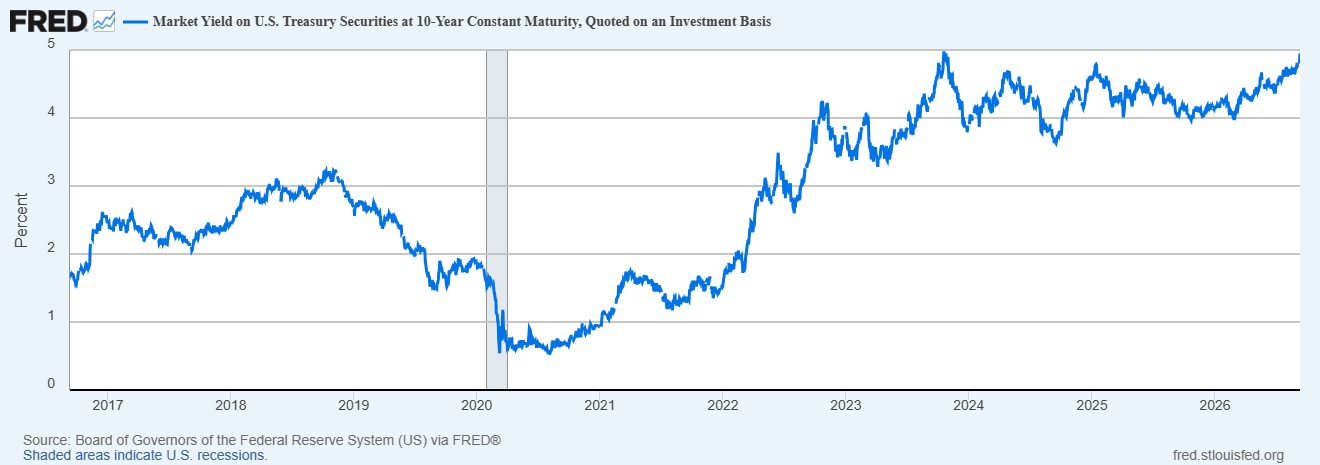
With U.S. Treasury bond yields marching higher and the national debt exceeding $40 trillion, entitlement spending has returned to headlines as the center of the fiscal policy debate. While it may be difficult to connect the dots on how these macro data points impact daily lives, entitlement spending has a clear and direct consideration for clients who are retired, or plan to retire. Entitlement spending (Social Security, Medicare, Medicaid, and other programs) comprises about 46% of federal outlays. For clients, Social Security has become a focal point with its role as a foundational piece of the multi-decade retirement cash flow plan. After decades of politicians kicking the can down the road, it appears the U.S. Treasury market is signaling its discontent with this unsustainable pace of federal spending.
For retirees and near-retirees, this naturally raises concerns. Fortunately, despite the alarming headlines, Social Security is not disappearing. Though the challenge is serious, policymakers have addressed the issue of Social Security funding before. Unfortunately, politicians procrastinate until the consequences of not resolving the issue exceed the pain of taking the steps needed for resolution.
Understanding the Problem
Social Security operates primarily on a pay-as-you-go system. Payroll taxes collected from today's workers (for 2026, 6.2% for employees and 6.2% for employers on the first $184,500 of wages) fund benefits for today's retirees. For decades, the program generated more revenue than it paid out, allowing reserves to accumulate. However, as the Baby Boom generation has moved into retirement, that relationship reversed. Benefit payments now exceed payroll tax revenue, forcing the system to draw down reserves.
The latest Social Security Trustees Report projects that the Old-Age and Survivors Insurance Trust Fund will be depleted in the fourth quarter of 2032- about six years from now. At that point, incoming payroll taxes would still cover approximately 78% of scheduled benefits, and Congress would need to act to avoid automatic reductions.
Several demographic factors contribute to the shortfall:
- Americans are living longer and collecting benefits for more years.
- Birth rates have declined.
- The ratio of workers to beneficiaries continues to fall.
- Payroll tax revenue has not kept pace with promised benefits.
- Slower population growth has further strained long-term projections.
The challenge facing Social Security is not unique. It reflects broader fiscal pressures associated with rising entitlement spending, persistent federal deficits, and increasing interest costs to service the ballooning national debt.
We've Been Here Before
The good news is this is not the first time Social Security has faced a funding crisis.
In the early 1980s, the program faced a similar solvency challenge. Congress responded with a bipartisan reform package that included gradually raising the Full Retirement Age from 65 to 67, accelerating payroll-tax increases, and making a portion of Social Security benefits taxable for some recipients. Those reforms stabilized the program for decades. It’s worth noting that this change only happened a few months before the funds would fall short on payments. A recent Wall Street Journal opinion piece examining the 1983 reforms argues that strong economic growth played a major role in restoring stability. Rising wages, lower inflation, and decades of economic expansion in the 80s and 90s helped generate substantially more payroll tax revenue than policymakers initially projected.
An often-overlooked aspect of the 1983 reforms is that many of the most significant changes were phased in gradually and largely targeted younger workers, rather than individuals already receiving benefits. The political reality was then, and remains today, that making substantial reductions for current retirees would be extraordinarily difficult and not politically expedient. This is no surprise to us, as we analyzed and wrote extensively on the subject in the blog article in May of 2024.
What Could Be Done to Fix Social Security?
There is no single solution. More likely, any eventual reform package will involve a combination of changes.
Raise the Payroll Tax Cap
Today, Social Security taxes apply only to wages below a certain threshold. In 2026, that cap is $184,500. Several lawmakers have proposed increasing or eliminating the cap altogether, requiring higher earners to pay Social Security taxes on a larger portion of their income. Advocates argue that this would generate substantial revenue and improve system solvency. Critics contend that dramatically increasing taxes on upper-income earners could create economic distortions and reduce incentives for work and entrepreneurship. As with most political wrangling, we wouldn’t be surprised if a hybrid approach was taken with a substantial increase in the wage cap or a “restarting’ of the taxation of wages at a higher income level.
Increase Payroll Tax Rates
The current Social Security payroll tax rate is 12.4%, split between employers and employees. Congress could gradually increase that rate. Even small increases would have a meaningful impact when applied across the entire workforce. Of course, higher payroll taxes effectively reduce take-home pay for workers and increase employment costs for businesses, something politicians may be hesitant to implement.
Increase the Full Retirement Age
One of the most commonly discussed reforms is gradually increasing the Full Retirement Age beyond today's maximum of 67. When Social Security was established, life expectancy was significantly lower than it is today. So, a modest increase in retirement age would reduce lifetime benefits while still preserving the program's core structure. Congress could also consider increasing the earliest claiming age from the current age of 62. Similar adjustments helped extend solvency during the 1983 reforms.
Slow Benefit Growth
Rather than cutting existing benefits, Congress could modify future benefits, with the brunt of the impact coming for workers below the age of 40.
Potential approaches include:
- Lower cost-of-living adjustments (COLAs)
- Reduced benefit growth for higher-income individuals
- Changes to how initial benefits are calculated
- Expansion of Social Security taxation rules, currently up to 85% of the benefit is taxed if AGI is over $44,000 (MFJ)
These proposals tend to be politically more palatable because they affect future growth rather than imposing immediate benefit reductions.
Modify Benefit Calculations
Benefits are currently calculated using a worker's highest 35 years of earnings. Congress could spread that calculation over more years, which would generally reduce average earnings and therefore reduce benefits for future retirees
Additional Borrowing
There is always another option: borrow more money.
Congress could transfer general tax revenue into Social Security or issue additional debt to bridge funding gaps. Such an approach would avoid immediate benefit cuts but would increase pressure elsewhere in the federal budget. Given current debt levels and rising interest costs, this seems to be the least palatable approach to the electorate and, more acutely, the bond market.
What Is Most Likely?
If history is our guide, Congress will probably not choose just one solution. More than likely, lawmakers may eventually construct a bipartisan package that includes some combination of:
- Higher payroll taxes for higher earners
- Gradual retirement-age increases for younger workers
- Modest benefit formula changes
- Adjustments to taxation of benefits
In other words, the burden will likely be spread across multiple groups rather than concentrated on current retirees. The most important point for today's retirees is that dramatic benefit cuts to existing beneficiaries remain unlikely, in our view. Social Security represents a substantial portion of retirement income for millions of Americans. Politically and practically, sudden reductions would be extraordinarily difficult to implement.
What Should Retirees Do?
The uncertainty surrounding Social Security highlights an important aspect of retirement planning: flexibility.
For individuals already receiving benefits or approaching retirement, we continue to believe that major reductions in current benefits are unlikely. For younger workers, it may be prudent to use more conservative assumptions when projecting future Social Security income. Most importantly, retirement planning should never rely on Social Security assumptions alone, and it’s a good idea to login to ssa.gov, check the benefit estimate and “hedge” it by only assuming some percentage of the current benefit estimate. A comprehensive plan considers many variables but must include a tax-efficient withdrawal and distribution strategy. In addition, other “unknowable” assumptions should be tweaked with a measure of conservatism to ensure the cash flow projection is stress tested for extreme circumstances. These would include higher inflation assumptions, higher healthcare costs, and longer longevity. Even if the stress test reveals some scary long-term projections, it is best to address them now when the most controllable factor (spending) can still have a positive impact. The goal is to build a retirement plan that remains resilient across a range of possible outcomes and not one dependent only on what Congress may or may not do.
Bottom Line
Social Security is facing a real and growing financing challenge. With trust-fund reserves projected to be depleted within the next decade and a national debt now exceeding $40 trillion, policymakers can no longer ignore the issue. The good news is that Social Security's problems are solvable. The bad news is that every solution involves tradeoffs.
Whether the eventual fix comes through higher taxes, modifications to future benefits, a higher retirement age, or some combination of all, history suggests Congress will ultimately act before widespread benefit reductions occur – even if it’s in the last possible moment. It’s really a question of when and what, not if, at this point.
For retirees and those nearing retirement, the answer is the same as it has always been: maintain a disciplined financial plan with conservative assumptions, remain flexible, and avoid making decisions based solely on alarming headlines. In short, sound planning has a wonderful track record of outlasting political dysfunction.
Published 09/22/2026
This material is for informational purposes only and does not constitute investment, tax, or legal advice. Opinions are subject to change and may not reflect current market conditions. All investments involve risk, including possible loss of principal. Past performance is not indicative of future results. Please consult your financial, tax, or legal advisor before making any decisions.